Skip to content

The IRIDX product

Measure, Manage, and Govern Third-Party Risk

IRIDX turns assessments, certifications, questionnaires and other assurance evidence into comparable, explainable measures of residual information risk and business-specific financial exposure, helping organizations make more consistent third-party decisions and govern exposure across the enterprise.

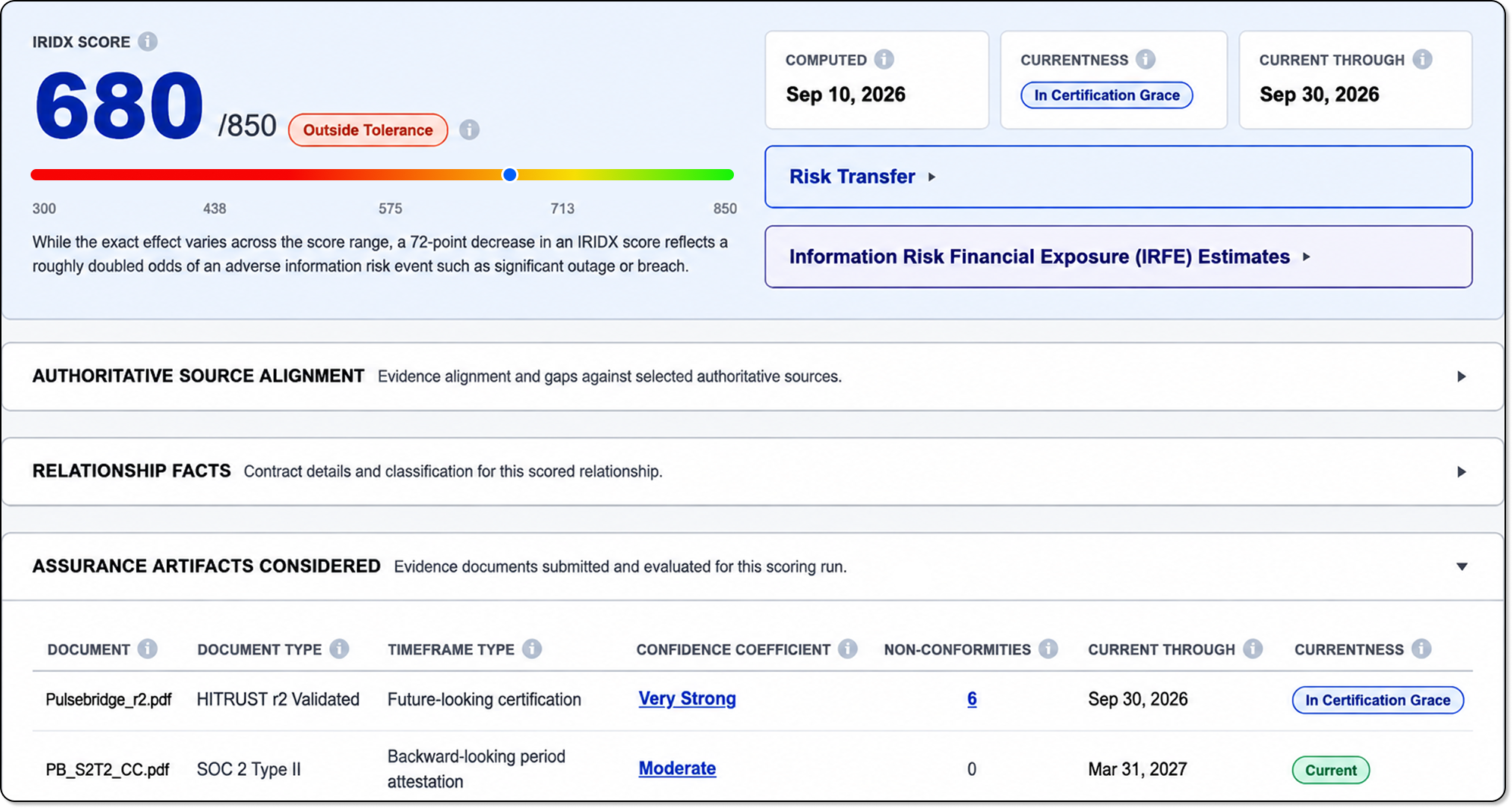
IRIDX score results showing risk score, assurance details, source alignment, and analysis sections.

What is IRIDX

Turn existing assurance evidence into measurable risk and financial exposure

Analyze the evidence you already have

IRIDX ingests assessments, certifications, questionnaires and other assurance signals, then Evidence Intelligence normalizes and evaluates them to determine demonstrated control support, evidence reliability, and gaps.

Get standardized, understandable results

Get a score of information risk, evidence-confidence insights, and estimates of business-specific financial exposure from a vendor relationship.

Put the results to work

Use measures to compare third parties, prioritize evidence requests and remediation, evaluate risk against tolerance, benchmark portfolios, govern exceptions and concentrations, and inform decisions to reduce, accept, retain, or transfer exposure.

How IRIDX works

From varied evidence to decision-ready risk intelligence

IRIDX works within existing assurance programs and processes. It ingests and normalizes commonly used assessments, certifications, questionnaires and other signals; evaluates control support and assurance reliability; and produces comparable measures that connect third-party review with financial and governance decisions.

Third-Party Management

Centrally manage your portfolio of vendors and suppliers and assurance workflow and activities.

Scoring

The IRIDX Score expresses information risk on a fixed 300–850 scale, while evidence confidence explains the strength, gaps and uncertainty behind the result.
Benchmarking

Compare vendors, portfolios, and thresholds on a common basis and add relevant peer context to risk, coverage, evidence confidence, exceptions and trends.

Information Risk Financial Exposure (IRFE)

IRFE combines risk and assurance-confidence signals with the service, contract and business context to estimate a scenario-based range of modeled gross financial exposure.

Governance

Place measured risk against approved tolerance, track coverage and ownership, and identify material exceptions and concentrations with dashboards and reporting that supports management action and board oversight.
Risk Transfer Enablement

Use the IRIDX score and IRFE to inform decisions about how much exposure to reduce, accept, retain, or transfer directly from within IRIDX.

Evidence → Analysis → Measurement → Action

  1. Evidence

    Existing assurance evidence

    Assessments, certifications, questionnaires and other assurance signals

  2. Analysis

    Evidence Intelligence

    Normalize, weight and explain

  3. Measurement

    IRIDX Score + Authoritative Alignment Scores + IRFE

    Comparable measures with distinct purposes

  4. Action

    Governance, benchmarking and risk-transfer decisions

    Use measures to guide the next decision

See how IRIDX can turn your existing evidence into precise action.

Request a Demo

IRIDX benefits

The Evolution of Third-Party Risk Management

Make reviews more effective

Use the assurance evidence that's available, reduce repeated interpretation and focus expert attention on the control weaknesses, evidence gaps and uncertainties that can change a decision.

Gain a true understanding of risk

Leverage comparable risk measures with business-specific financial context to support targeted improvement, explicit risk acceptance and informed decisions about how much exposure to retain or transfer.

Govern the entire portfolio

Track review coverage, risk against tolerance, exceptions, trends, shared dependencies and concentrations, giving management and the board a consistent basis for oversight and action.

“IRIDX provides a standardized view of vendor information risk. The IRFE methodology evaluates the financial consequences of vendor breaches to support an organization's risk management strategies. After a thorough review of these methodologies and the underlying data, HDR fully endorses the approach and the quantified view of third-party information risk they provide.”

Douglas W. Hubbard, Founder of Hubbard Decision Research and Author of How to Measure Anything in Cybersecurity Risk

Your questions

Frequently Asked Questions

What is IRIDX, and how does it help organizations manage third-party information risk?

IRIDX is an information risk ratings solution that gives organizations a consistent way to understand and compare the risk associated with vendors and other third parties. It helps leaders see which relationships need attention, how confident they can be in the available assurance information, and where risk management action may be required.

How can IRIDX support third-party risk governance, benchmarking, and risk management decisions?

IRIDX helps organizations compare third-party risk against their approved tolerance, identify important exceptions and concentrations, track changes across their vendor portfolios, and help leaders decide which risks to reduce, accept, retain, or transfer.

What is the IRIDX Score, and how does it measure information risk?

The IRIDX Score is a standardized 300–850 measure of the information risk after considering a third party’s controls and the reliability of the evidence supporting them.

How does IRIDX Evidence Intelligence evaluate assessments, certifications, questionnaires, and other assurance evidence?

IRIDX Evidence Intelligence reviews assessments, certifications, questionnaires, and other available evidence to determine what each source actually shows and how much confidence it deserves. It brings different evidence together consistently while highlighting gaps, outdated information, and duplication that could affect a risk decision.

What is Information Risk Financial Exposure (IRFE), and how does it estimate the financial impact of third-party risk?

IRFE translates the risk associated with a specific third-party relationship into estimates of potential financial exposure. It combines the IRIDX risk assessment with information about the vendor’s services, contract, business importance, and possible impact, with estimates shown before insurance or other financial protections are applied.

Go From Uncertain to Confident

See how IRIDX can help your organization understand third-party information risk, determine financial exposure, and make decisions with a consistent measurement foundation.

Request a Demo